

 Our project
European Soil Erosion Monitoring and Modelling Network for Sustainable Agricultural Land Management
Project overview
The EUROSION project aims at creating a robust monitoring network to assess soil erosion status and trends across spatial and temporal scales and promote best management practices to agricultural land managers and decision-makers to reduce soil erosion.
Erosion is a major threat to the ecosystemic services provided by soils, especially for nutrient cycling, provision of food, water purification, leading to significant on- and off-site effects that need to be monitored, studied and prevented. To tackle these pressing challenges, the European Union launched on November 1st, 2025, EUROSION, a large-scale research and innovation project with a budget of €11.49 million, bringing together 24 partners from 13 countries, stretching from Tunisia to Norway and United Kingdom to Türkiye.
EUROSION aims to advance knowledge, develop innovative solutions, and support effective strategies to protect soils and sustain their vital functions for ecosystems and society.
By providing an integrated, harmonized, and dynamic understanding of soil erosion, EUROSION directly contributes to the European Soil Strategy and the European Green Deal.
The project also aligns with EU goals for sustainable agriculture and climate resilience, supporting evidence-based decision-making for soil protection across the continent.
The project’s framework
EUROSION aims to establish the first pan-European dynamic soil erosion monitoring network. The project relies on 14 monitoring nodes, acting as open-air laboratories, covering the main erosion processes: water erosion, tillage erosion and wind erosion.
Our 5 Objectives
- Develop a multi-scale Monitoring Network and provide up-to-date and accurate data
- Enhance, calibrate, and validate existing process-based erosion models to estimate soil erosion across space and time
- Develop a platform to facilitate the collaboration between monitoring stakeholders and provide access to soil erosion data and knowledge
- Provide farmers with recommendations on best practices for reducing soil erosion
- Providing policymakers with recommendations enhancing the adoption of practices reducing soil erosion
Work packages scheme
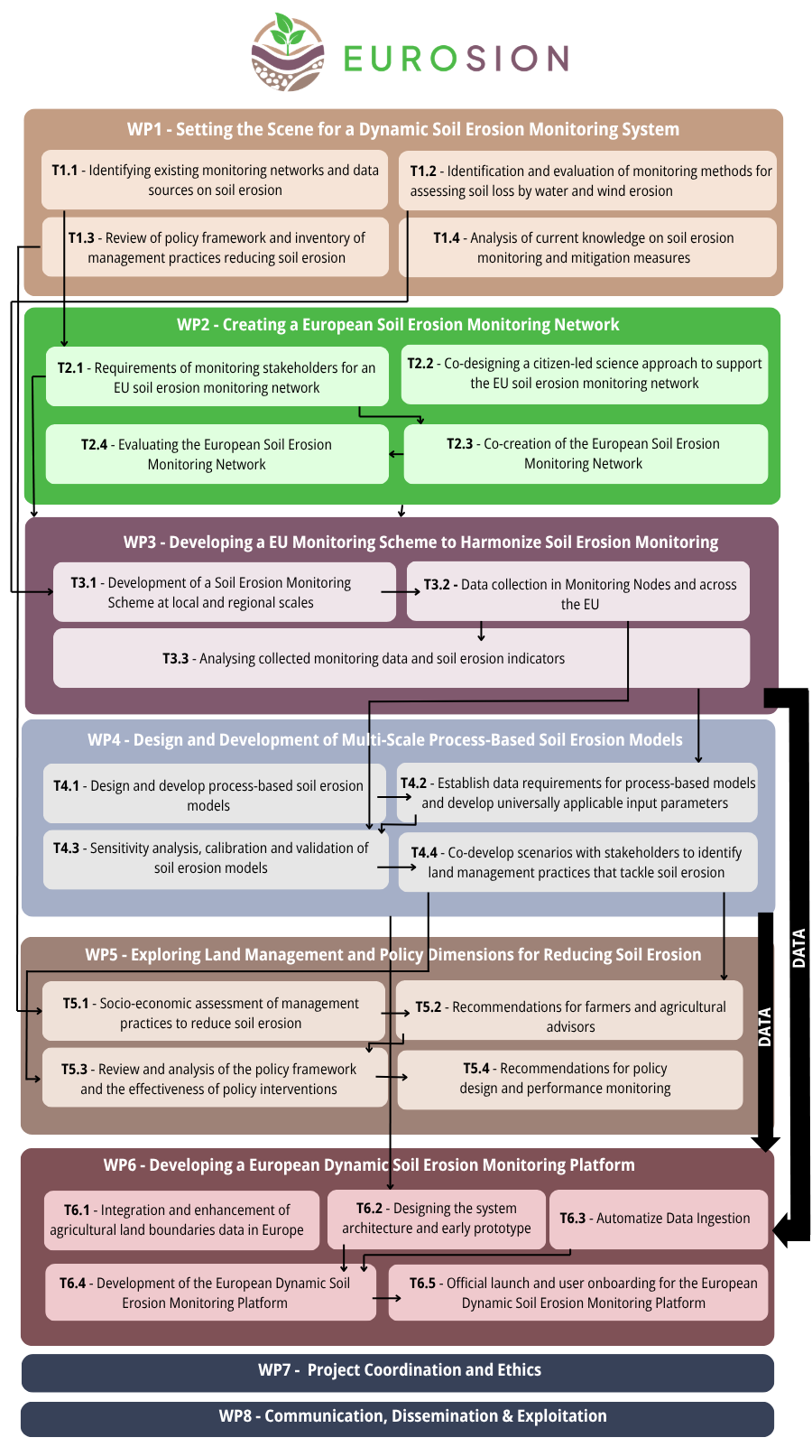
The Work Plan is organised along 8 Work Packages (WP) spanning 60 months of project in total, from November 2025 to November 2030.
| WP1 | WP Leader/Task Leader |
| Setting the scene for a dynamic soil erosion monitoring system | NIBIO |
| T1.1 - Identifying existing monitoring networks and data sources on soil erosion | NIBIO |
| T1.2 - Identification and evaluation of monitoring methods for assessing soil loss by water and wind erosion | BFH |
| T1.3 - Review of policy framework and inventory of management practices reducing soil erosion | CYI |
| T1.4 - Analysis of current knowledge on soil erosion monitoring and mitigation measures | NIBIO |
| WP2 | WP Leader/Task Leader |
| Creating a European Soil Erosion Monitoring Network | UoG |
| T2.1 - Requirements of monitoring stakeholders for an EU soil erosion monitoring network | UoG |
| T2.2 - Co-designing a citizen-led science approach to support the EU soil erosion monitoring network | UoG |
| T2.3 - Co-creation of the European Soil Erosion Monitoring Network | UoG |
| T2.4 - Evaluating the European Soil Erosion Monitoring Network | UoG |
| WP3 | WP Leader/Task Leader |
| Developing a EU monitoring scheme to harmonize soil erosion monitoring | BFH |
| T3.1 - Development of a Soil Erosion Monitoring Scheme at local and regional scales | BFH |
| T3.2 - Data collection in Monitoring Nodes and across the EU | BFH |
| T3.3 - Analysing collected monitoring data and soil erosion indicators | BFH |
| WP4 | WP Leader/Task Leader |
| Design and development of multi-scale process-based soil erosion models | UT |
| T4.1 - Design and develop process-based soil erosion models | UT |
| T4.2 - Establish data requirements for process-based models and develop universally applicable input parameters | KUL |
| T4.3 - Sensitivity analysis, calibration and validation of soil erosion models | KUL |
| T4.4 - Co-develop scenarios with stakeholders to identify land management practices that tackle soil erosion | NIBIO |
| WP5 | WP Leader
/Task Leader |
| Exploring land management and policy dimensions for reducing soil erosion | IEEP |
| T5.1 - Socio-economic assessment of management practices to reduce soil erosion | HFFA |
| T5.2 - Recommendations for farmers and agricultural advisors | UoG |
| T5.3 - Review and analysis of the policy framework and the effectiveness of policy interventions | IEEP |
| T5.4 - Recommendations for policy design and performance monitoring | IEEP |
| WP6 | WP Leader/Task Leader |
| Developing a European Dynamic Soil Erosion Monitoring Platform | VARDA |
| T6.1 - Integration and enhancement of agricultural land boundaries data in Europe | VARDA |
| T6.2 - Designing the system architecture and early prototype | VARDA |
| T6.3 - Automatize Data Ingestion | VARDA |
| T6.4 - Development of the European Dynamic Soil Erosion Monitoring Platform | VARDA |
| T6.5 - Official launch and user onboarding for the European Dynamic Soil Erosion Monitoring Platform | VARDA |
| WP7 | WP Leader/Task Leader |
| Project coordination and ethics | WU |
| T7.1 - Management and coordination tools | EQY |
| T7.2 - Day-to-day management | WU |
| T7.3 - Ethic requirement, risk management and quality assurance | WU |
| T7.4 - Data management | VARDA |
| WP8 | WP Leader/Task Leader |
| Communication, Dissemination & Exploitation | EQY |
| T8.1 - Plan for dissemination and exploitation including communication activities | EQY |
| T8.2 - Communication activities | EQY |
| T8.3 - Dissemination activities | EQY |
| T8.4 - Collaboration with sister projects and other projects | UNIPD |
| T8.5 - Exploitation activities | EQY |